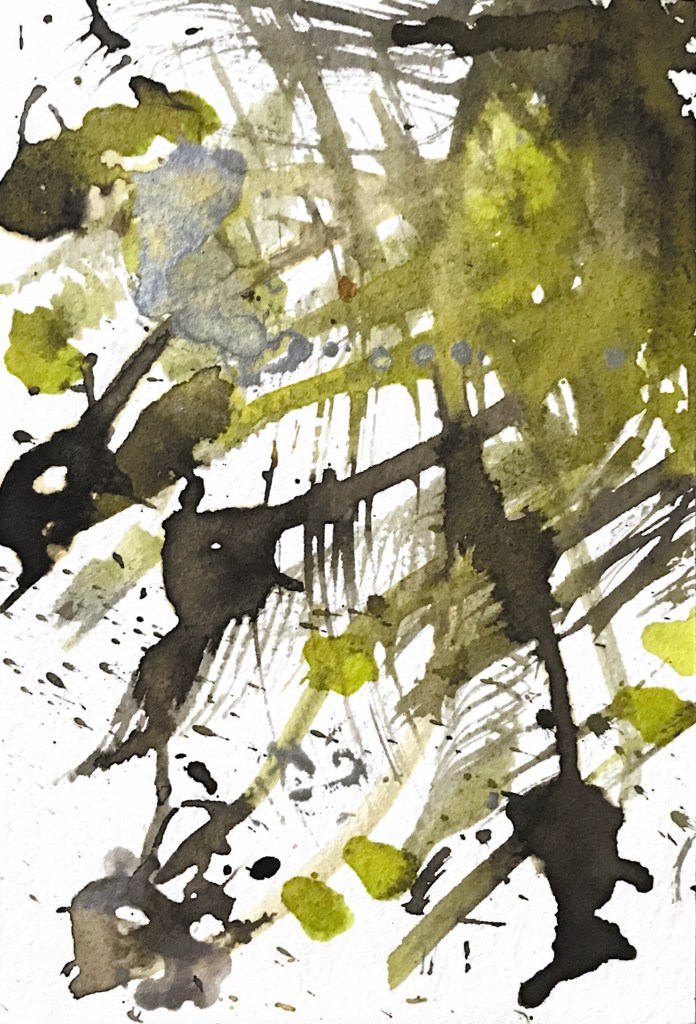
Having worked most of my way through ATV Part 5, I realised that my work was quite controlled at the drawing stage and felt I needed to experiment further. I used inks and homemade tools to create these pieces in my sketchbook, and then used my flower drawings to suggest marks for stitching for some of them. Some of the pieces have been cut up into smaller pieces and I now have an idea to create more ink paintings to make collage shapes.
For this piece I returned to my inspirational artist Eric Carle and to a sample I made using a shape I particularly like from one of my drawings. When I made the sample it was with paper on a white background. However Eric Carle has used coloured backgrounds later in his career so I decided to do this and to use painted fabric to make the shapes.
Paper paper collage by Eric Carle
Paper paper collage by Eric Carle using repeated images.
Eric Carle collage on a coloured background
Black and white outline of one of my paintings with image in the lower right hand corner that I used.Paper painted shapes on white background – sample used to developFinal piece number 5
Close up image of piece number 5
Close up image of piece number 5
I have used watercolour paint on collaged fabric and some free machining before cutting out the shapes. I think the technique of painting fabric is something I would like to develop further – I like the randomness of piecing and painting before cutting – never quite sure of what you will get.
The fabric pieces I have made for my capsule collection are in a much brighter colour palette than the watercolour paper and crochet pieces. For my final piece I want to combine paper and fabric to create a 3d explosion of colour and texture.
Piece number 6
I wanted to use paper weaving and fabric shapes but also to include a 3d element. I used two shapes from a different drawing to make leaves and a flower shape rolled into a cone. I combined this with paper using a previous sample as a starting point.
Drawing used for leaf and flower shapes
Sample combining paper weaving and fabric shapes
Final piece number 6
The final piece has a lot of texture and movement with variations of scale. Some parts you need to look at closely to appreciate while from further away it is vibrant and exciting.
Close up of piece number 6
Close up of piece number 6
Image from piece number 6 altered with computer app – ‘Waterlogue’
Image from piece number 6 altered with computer app – ‘Waterlogue’
I am really pleased with the computer altered images and can see that these would provide further inspiration for collaged textile pieces.
For this piece I have continued with the colour scheme from my yarn wraps done in response to my paintings, together with shapes from my drawings, and a weaving sample done with strips of fabric. This time I arranged my shapes among the warp threads and wove from the back of the piece, leaving only the warp threads showing over the shapes.
Yarn wraps
Weaving sample used for inspiration
Initial placement of shapes prior to reversing
Ripped fabrics ready to weave
Final piece number 3
Close up image of piece number 3
Close up image of piece number 3
Piece number 4
For this piece I turned to my yarn and linear concepts and a fringe sample. My final piece includes leaf shapes, cords and paper beads to suggest buds.
Paper fringe
Yarn and linear concepts
Original fringe sample
Final piece number 4
Close up of piece number 4
Close up of piece number 4
I am enjoying developing my samples into a collection, using different materials and techniques within each piece. I like the combination of yarn, paper, fabric and painting creating interesting pieces with movement, texture and detail.
The inspirational weaving of Sheila Hicks
While creating my capsule pieces and looking at inspirational artists, I have come across the works of Sheila Hicks, who creates large scale and small textile works including many pieces of weaving.
I have selected a few to include that I absolutely love.
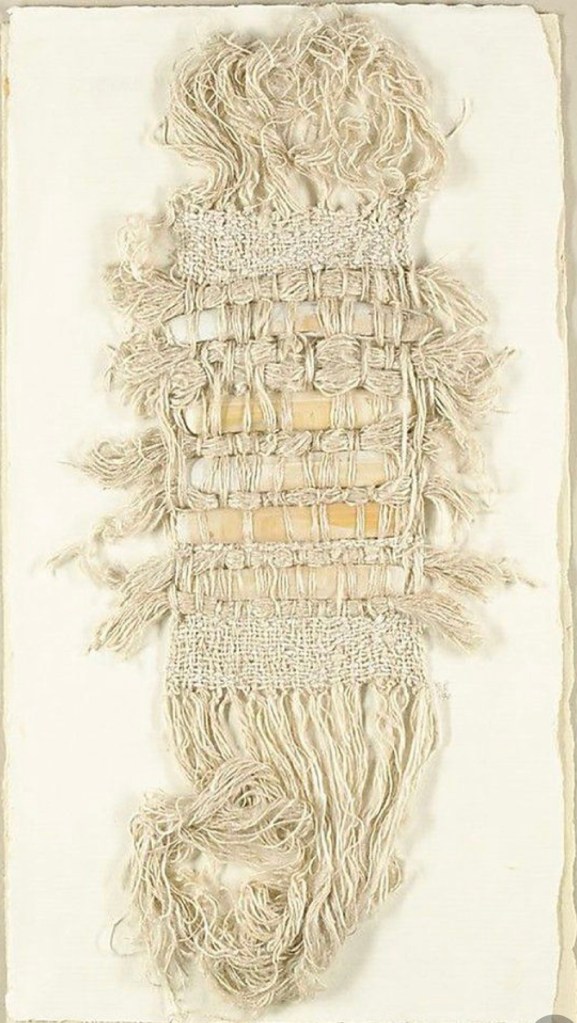
The colours in these pieces are beautiful. Some are harmonious and some are not. I particularly like the technique of wrapped cords within the pieces and the texture created by different weaving methods.
These pieces use different materials, different thicknesses of weft and warp ‘threads’ and more of a natural colour scheme. There is a lot of texture, movement and detail in these pieces which are not as simple as they first appear.
I have decided to build a collection based on samples I have created with a running theme of colour, shape, construction and materials. I want each piece to have inspiration from my floral theme and to combine materials and techniques.
Piece number 1
I have used a sample weaving piece made from painted watercolour paper as my inspiration, and developed this with further yarn wrapping to suggest flowers. This weaving is more complicated than the original sample and combines the geometric patterns of the weaving with the painted lines and wrapped thread to retain a light floral feel.
Painted watercolour papers
Sample used to inspire for developmentFinal piece number 1
Close up of Piece number 1
Close up of Piece number 1
Piece number 2
For the second piece I combined pieces of painted watercolour paper with crochet. I used shapes from my original drawings and sample pieces of paper with crochet as my inspiration.
Original drawing with petal shape
Original drawing with leaf shape
Sample piece of crochet on paperFinal piece number 2
Having produced a lot of painted paper for my previous samples I wondered if I could apply the same method to fabric. Fabric needs to be flat to paint on and I thought a fusible webbing or iron on interfacing would be a good backing for my fabric pieces.
So for my first samples I used what I had – iron on interfacing, and I applied strips of cotton and silk fabric, some commercially dyed, and some tie dyed by me. I also have a lot of saris – some polyester and some silk with embroidery on them, and I included some of these. I then used the same principles as I did for my paper painting and used watercolours to create patterns within my colour scheme.
My first experimental samples were made from these fabric pieces and cord made on my sewing machine. I have pushed the ideas of weaving with my shapes and making a fringe.
Woven fabric strips with added painted fabric shapes
I also combined some stitching and crochet on some fabric shapes.
For my next sample I painted wooden beads before wrapping them with thread and adding paper stems.
I wanted to try something more 3D so experimented with painted tissue cut into one of my shapes and wound around into a tube shape. These pieces were then glued together onto a piece of paper. I’m thinking this technique could also work with stiffened fabric.
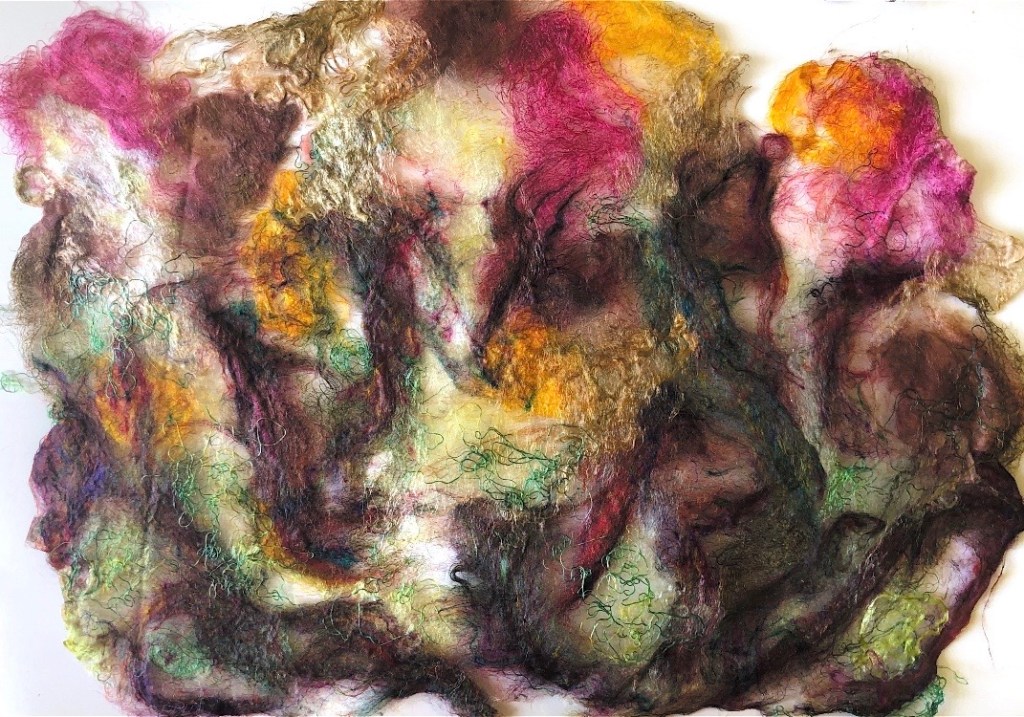
I wanted to try mixing different techniques so I made felt and added paper shapes.
I also made silk paper and then used this to make shapes and to weave with.
Silk paper Silk paper weaving with added stitched real pressed petals.
Thinking about experimenting and taking risks,- I have approached this exercise with the thoughts of using different materials to work with and to combine them in unusual and interesting ways. I have been brave with my colour combinations and patterns, and I have deconstructed materials such as the silk paper I made, and painted pieces, to use to reconstruct by weaving and stitching in experimental combinations. I have achieved much more texture and visual interest in my samples to inspire me for my capsule collection.
I feel I have developed my own techniques and used my materials sensitively. I have brought a sense of scale with shapes and fine crochet work.
Inspirational artists
As part of this journey I have also discovered two more artists who have inspired me.
Tara Axford is a mixed media artist who works with prints, collage, mixed media, fibre arts and photography. I was particularly inspired by her watercolours and her collage work. I like the simple shapes and her use of colour.
Nancy Brett is a painter and weaver. I am drawn to the colours, texture and apparent simplicity of her pieces, some of which are quite formal and others more free in the use of materials and the structure.
How could I not be inspired by Eric Carle? – I love colour, collage and paper! His beautiful collage illustrations came to mind when I started to think about building a response to my floral composition drawings in Project 1.
Eric Carle in front of a backdrop of brightly coloured collage. I love the colours and pattern, overlaid and vibrant with movement and tone.
Eric Carle grew up in Germany and had a love for drawing and painting at school. His passion was noticed by a teacher at high school who introduced him to abstract and expressionist art at a time when these works were banned. He went on to study graphic art at the Akademie der bildenden Kunste, in Stuttgart before moving to the US in 1952 where he worked as a graphic designer for the New York Times and then as an Art Director for an Advertising agency. In the mid 1960s an advert with a picture of a red lobster by Eric Carle was spotted by Bill Martin Jr and he asked Eric Carle to illustrate ‘Brown bear brown bear what do you see?’.
Examples of Eric Carle’s work
The examples below show a range of collaged illustrations on a white background. While the shapes are simple the colours are complex and have lots of pattern to create different tones, texture and movement. Every time I look at them I see something different. The translucency of the tissue creates an ethereal look to many of the pieces.
Way of working
Eric Carle uses painted tissue paper to create his collages. He starts with plain tissue which he paints with acrylic paint in different colours. He uses wide and narrow brushes, straight and wavy strokes, and his fingers to create patterns. He then uses carpet, burlap (rough cloth) or sponge to make a stamp and add more colour. The resulting papers are stored in colour coded drawers ready for use. He may also revisit painted papers stored in his ‘ideas box’.
He sketches ideas for his pictures in a dummy book and when he is ready to create a collage he selects papers, cuts out shapes from his drawings and sticks the pieces with wallpaper paste.
Eric Carle’s early illustrations are collaged onto a white background as in the examples above, however after a two year sabbatical where he made abstract art from painted tissue, fabric, glass, foil and plastic, he started to illustrate his books with collages made on coloured tissue backgrounds. These are much more complex in the application of colours and tones.
Coloured tissue background
Coloured tissue background
Eric Carle very generously shares his working methods on his website with colouring pages and instructions for painting tissue papers.
Colouring sheet from Eric Carl’s website
From the Eric Carle website – a free download
HOW TO PREPARE PAINTED TISSUE PAPERS:
Squeeze paint (acrylic, water or poster paint) into a dish, add water and stir
Place a single sheet of tissue paper on a clean surface
Paint bold strokes onto the tissue paper. (Hint: lift up tissue paper briefly, so it doesn’t stick to the surface.) Let it dry on newspapers while working on other tissue papers.
Apply a second colour. Perhaps in wavy blue brush strokes. Again: lift tissue paper and let it dry on newspapers.
Apply a third colour. Yellow dots might look nice.
Apply a fourth colour. Perhaps black painted onto a piece of carpet which can be used to make textured prints on top of the red, blue, and yellow design. HOW TO MAKE A COLLAGE ILLUSTRATION:
Draw a caterpillar (or any creature you like) onto tracing paper or other transparent paper.
Place the drawing on top of a red tissue paper and (Scissors/blade?) cut through both tracing and tissue papers. Be careful!
Cut out each section at a time: First the face, then each segment of the caterpillar.
Turn the face over and apply a thin later of glue or wallpaper paste.
Paste it onto a white illustration board or similar material.
Cut out the first green segment of the caterpillar’s body.
Place the tracing paper, with head and body segment removed, as a guide for pasting down the green segment.
Repeat steps 6 & 7, selecting different shades of green for each segment until the body is finished.
Carefully cut out the eyes: Moisten the area around the eyes; wait a second, lift a remove the eyes.
Cut out yellow, green, and brown parts for eyes, nose, and feet, and glue them into their places.
Use crayons or coloured pencils for the final touch
Other artists using collage
Ezra Jack Keats 1916-1983
Leo Lionni 1910-1999
Picasso 1881-1973
Henri Matisse 1869-1954
Paul Klee 1879-1940
Inspiration and favourite artists
Paul Klee
Eric Carle is quoted as saying that he is inspired by the colourful dreamlike qualities of Klee’s work. These too have an ethereal quality.
Brughel 1525-1569
Eric Carle grew up in Germany and on his website he says that the paintings of peasants and landscapes by Brueghel remind him of this.
Other work by Eric Carle
Angels
At the age of 87 Eric Carle started creating abstract angels as a tribute to the many angels painted by Paul Klee. They do not represent Klee’s work but are inspired by them and made from items found on the floor and wastebaskets of Eric Carle’s workroom.
My work, inspiration and reflection
I started by painting papers but used book pages, maps, watercolour paper and newspapers. Eric Carle is quoted on his website as saying that his favourite colour is yellow due to how it mixes with other colours. My favourite colour is green as I always find that a splash of green ‘lifts’ any painting/textile that is otherwise lacking that extra ‘something’. Having said that I have used a lot of yellow both on its own and in mixing to make other colours.
The papers I made lack the translucency of Eric Carle’s papers and so do not produce the ethereal quality of his pieces – maybe I should explore this in future samples.
Painted watercolour paper
Painted cartridge paper
Papers created for ATV Part 3 on book paper, newspapers, and maps
I used the papers I created to cut simple shapes based on my drawings, and then experimented further with collage ideas. I love the randomness of cutting shapes by drawing on the back of painted papers and not being sure how the pattern will fall on the right side.
Yarn and linear explorations again capture the collage inspiration.
I am really happy with how this experimentation is going. I started the experiments without an artist in mind, but as I progressed Eric Carle jumped into my head and having spent some time researching his way of working I am inspired to experiment further. As I mentioned before I am keen to work with tissue paper now to capture a lighter feel as a contrast to the samples I have produced so far.
Woven paper collage using shapes and strips developed for previous samples in this projectWoven threads and strips of fabric with cut out fabric ‘petals’.
I am really pleased with both the paper and fabric woven samples that I have made during this project and feel they could be developed further for my capsule collection.
The fabric and yarn weaving above has a lovely ‘painterly’ feel and reflects the collage inspirations of my earlier samples. I like the simple shapes of the petals contrasting with the more complicated colour combinations of the weaving and the fabric strips from which the shapes are cut.
For these first linear concepts I worked with my colour scheme and also with the mood of my paper collages.
I used threaded beads, kumihimo braiding, buttons sewn to ribbon, machine made cord with attached organza pieces and paper leaves, pleated organza strip with added paper bud shapes, machine stitched paper leaves, and cord knotted with random silk caught in.
I used the paper from my collage samples to make the leaves and bud shapes and I feel these linear samples relate well to my previous work in this Project. They also capture the spirit of my inspiration from Eric Carle with the abstract patterns, bright colours and collage pieces.
In my mind these samples also give me ideas for stitch.
Textile concepts
Firstly I made another collage sample using my painted papers and together with a cord made on my sewing machine I stitched a collage together.
This got me wondering about painting fabric in a similar way to create fabric collages.
Firstly I bonded silk, cotton and organza with double sided webbing and then painted the pieces using watercolour and gouache paints. This was more successful than I could have hoped for and created inspiring fabrics for my collages.
Painted fabricPainted fabric
Having cut out shapes from the templates I developed for the paper collages, I then arranged the following collages.
These are now ready for some hand stitch.
Also today I tried ironing real flowers onto fusible webbing and covered them with organza.
I am still inspired by the work I am doing with paper so I have decided to stick with this for the moment.
I have created some more painted watercolour pieces inspired by my colour scheme and original drawings and used these to create a layered sample.
Layered sample with lots of ideas for stitching.
For the following samples I have used the watercolour paper pieces and offcuts from my work on collage at the start of this project.
Stitch ideas on collage paper made with offcuts.
Rolled paper beads wrapped with threads and topped with painted paper leaves
Watercolour squares wrapped with embroidery threads
Woven strips of watercolour paper with some squares wrapped with embroidery threads. This piece has an oriental feel I think – maybe wabi sabi – simple and embracing imperfections?
Paper tassel made with watercolour paper, wrapped with thread and topped with painted leavesWatercolour squares stitched togetherWatercolour painted paper with petal shapes cut out and stitched, overlaid on collaged painted papers.
Woven offcuts of painted watercolour paper with handmade beads from the same papers
Inspiration
Watercolour paper pricked with a darning needle from the front
Reverse view
Inspiration
Offcuts of painted watercolour paper cut into squares and randomly arranged as a mosaic
I particularly enjoyed the weaving and mosaic making – I like the randomness of the result which still retains much of the feel of the original inspiration. Working with watercolour paper is particularly satisfying – I like the feel of it and the way it tears and cuts. It is strong and I intend to use it for some stitch samples next.
Just been painting some watercolour paper ready to use for stitched samples








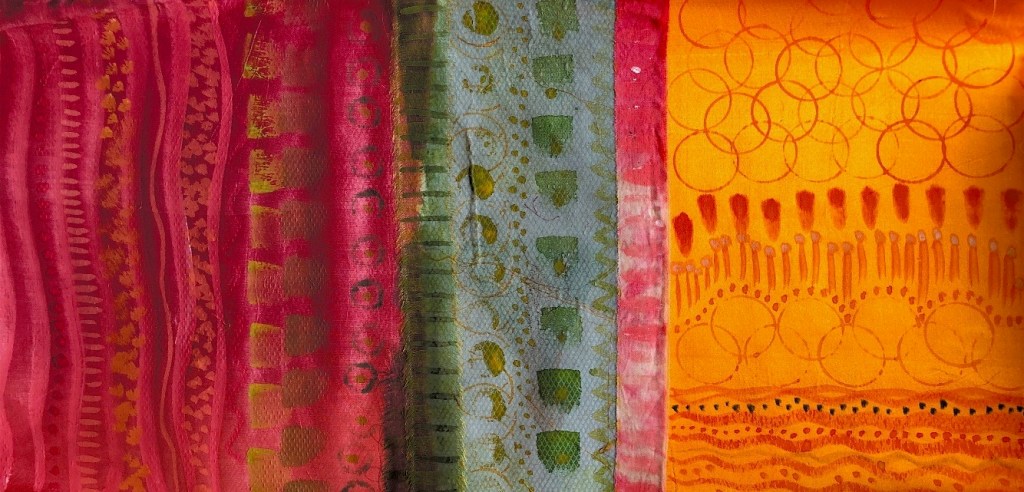


 Paper and stitch