Author Archives: paper and stitch

Unknown's avatar

About paper and stitch

I am a textiles student with OCA

Textiles 1 Part 4 Yarn and linear exploration Project 2 Creating linear forms Exercise 4.4 Deconstructing colour as yarn

Inspiration from exercise 3.3 Watercolour studies
Material selection including organza ribbon, plied silky yarn, plied wool, silk fabric, lace, cotton fabric and silk waste.

Ideas for deconstruction –

slashing, tearing, shredding, stabbing, puncturing, fringing, untwisting

Slashed silk fabric and organza ribbon
Silk fabric partially deconstructed by pulling out threads
Ripped and deconstructed silk fabric
Cotton hand dyed fabric with strands pulled out
Silk fabric ripped and shredded
Silky yarn unwound to single ply
Chunky knitting wool untwisted to single strands
Hand dyed silk waste pulled apart
Lace, cut into a fringe with scissors
Design 1. Slashed silk, woven with unplied wool, yarn and silk threads
Design 2. Partially deconstructed silk embroidered with unplied silky yarn
Design 3. Slashed and ripped organza ribbon with tied pieces of silk waste, cut lace, ripped silk and unplied wool
Design 4. Fringed lace plaited with ripped organza and unplied knitting wool
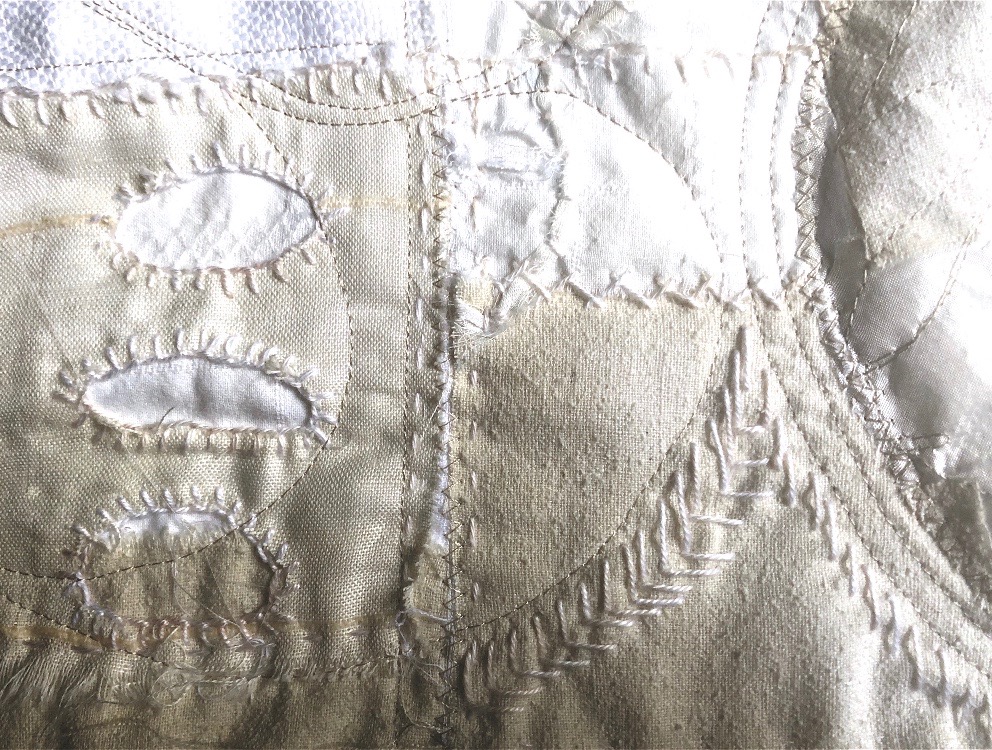
Design 5. Deconstructed threads enclosed in organza and stitched
Design 6. Partially deconstructed cotton fabric woven with unplied threads and wool

This was such a different exercise to carry out after the last one and I really was inspired by the transparency of the materials and the deconstruction methods, enabling me to recombine them using the watercolour studies as inspiration. I think they are very effective and demonstrate a new approach to yarn construction.

Textiles 1 Part 4 Yarn and linear exploration Project 2 Creating linear forms Exercise 4.3. Re-interpret, re-invent

For this exercise I started with the yarn wraps created in response to the painting ‘The Birth of Venus from Part 3 Exercise 3.2.

Fabrics and yarns gathered ready to begin

For the constructed forms I chose to start with Kumihimo braiding using a range of yarns and fabric strips. I also then used one of the cords to create a Chinese good luck knot. This is a time consuming process to make a cord long enough to use for knotting but I am pleased with the results. I also found that using a combination of thick and thin materials created texture and interesting spiral patterns.

Kumihimo circle laid out for a simple braid
Kumihimo

The next technique I tried was cord/rope making, again with various materials. I did find that some materials dominated if they were very thick and meant that the cord wasn’t as detailed as when finer even materials are used.

With one finer cord I tried making smaller knots

I enjoyed using simple macrame and with this technique colours can be changed so that the result looks very different to cording or Kumihimo. The resulting macrame knots can be very even or can be uneven and may be manipulated.

Simple macrame showing changes of colour, uneven knotting, and manipulation to create bobbles.

Moving on to crochet which is a love of mine, I decided to use the yarn wraps from the painting ‘The Lacemaker’ as my inspiration. I used simple stitches but created interest with different materials and use of these stitches (double and treble crochet).

Lots of different uses of simple crochet stitches to make flat braid, twists and curls, wrapped cord, edging, zig-zag braid, and a picot cord. I have concentrated on the richness and depth of colour in my yarn wraps .

Research

For research into the different techniques used, I have consulted the huge range of books that I have at home and also the internet for diagrams and tutorials. Due to current social isolation I have used materials that I have in my craft room including silk fabric, cords, embroidery thread, ribbons, sari silk and knitting wool.

Reflection

With each technique used I have tried to concentrate on texture, colour and overall effect of the yarn wraps. I deliberately kept the techniques simple to create but decided to use these techniques in ways that made the results different to what you would expect, with materials, colour combinations and changes, and combinations of stitches and techniques. I wanted the samples to reflect me and my ideas rather than just to present the techniques, and I feel I have achieved this.

Some samples have not really shown off the colours and inspiration to full effect but they are still valid and could be combined with further explorations so I don’t see anything as a failure.

I realised that I love working with Kumihimo cord but this is very time consuming to produce. I also enjoy working with sari silk, and the lovely fluffy edges which can be exploited by leaving ends to fray . Uneven knots also create interest. I like the contrast between smooth fine embroidery threads, dull textured wool, and shiny frayed silk. Using similar techniques to those used to produce neat braids and crochet but in a more ‘freeform’ way has demonstrated my own creations and inventions.

I found the colours from ‘The Lacemaker’ wraps made a much bolder statement and these were well interpretated in my crochet pieces. I am pleased with the combinations of colours this has produced, and while the samples are clearly derived from the yarn wraps they have been re-invented and re-interpreted to show my personal voice.

Textiles 1 Part 4 Yarn and linear exploration Project 2 Creating linear forms. Review point Demonstration of creativity

I have been lucky throughout my study so far to have access to a wide range of materials at home and this has enabled me to create interesting work such as the colour wraps in response to the Old Master paintings in Part 3 Exercise 3.2, and creative yarns in Part 4 exercise 4.1.

In Part 4 so far I have seen how drawings of totally unrelated textiles can inspire a whole new body of work and I have demonstrated this in the diverse and interesting yarns that I have made. I have become more experimental for example in the materials I have used such as plastic and cocktail sticks and have used a variety of techniques.

I created very successful crochet pieces in response to the watercolour studies in Part 3 Exercise 3.3 Watercolour studies and this is an indication of me using and finding my personal voice.

I have worked on my presentation and this in turn has inspired me to be creative in mounting and photographing my work.

I want to build on the process of working through colour schemes and images to create a new idea and then to continue this process to achieve work that shows my personal voice.

For me the part of my supporting work that needs to develop most is my sketchbook. In these times of isolation I think a challenge of creating at least one entry each day, however small, will get me into a habit of using my sketchbook successfully.

With regards to Project 2 I would like to take a more simple refined approach to the pieces I create and to concentrate on method, texture and colour.

Return from isolation

I have now returned from 5 weeks at sea! I was supposed to join a cruise ship for two weeks to teach craft classes to the guests but due to Covid-19 I was not able to leave the ship. There was no virus on the ship but no ports would take us so I stayed on the ship for 5 weeks, continuing to teach craft with the materials I had. See pictures below.

Now I’m back and following a move of my craft room from upstairs to downstairs (where there is more light) I’m ready to get started again.

Textiles 1 Part 4 Yarn and linear exploration Project 1 Exploring lines . Exercise 4.2 Experimental yarns and concepts

  1. Colour placement and composition
In these four samples I have used the colours from the design in different proportions, creating very different combinations. The method of combining the colours such as Kumihimo braiding, wrapping, plaiting with french knots, and tied strips also affects the overall look of the colour combinations and which ones stand out.

2. Materials exploration

The bright colours and shapes in this fabric made me think of plastic circles, some of which I have wrapped with yarn to echo the pattern and shapes. It also made me think of apples!
Buttons also came to mind when I was looking at the shapes in this pattern – layering them in this way creates the ring effect of the fabric design.
I wanted to use some natural materials and found this pot pourri in my bathroom; on closer inspection the longer pieces turned out to be corrugated cardboard but this also fitted the theme. I have attached them to fabric with a chain stitch.

3. Texture and tonal qualities

The first fabric sample is shiny and has sequins in it while the second is textural, woven and matt. I tried to show these features in my yarn designs. I have used a Kumihimo disc, trapped raffia, yarn wrapping, and stitched sequins.
Pushing the concept further I concentrated on weaving inspired by the first fabric piece, using yarns and cocktail sticks, and including colours from both fabric studies.
For this piece I used a bolder approach with strips of fabric and textured yarn in my weaving. I tore a piece of the original fabric into strips to use, and also used a plastic circle to echo the sequins.

Looking at what I have achieved in this exercise I can see how important it is to make samples and try out lots of ideas when exploring an idea. The concept of developing a series and then revisiting to exaggerate, and push the idea further has been exciting. I have used materials that I have been able to find in my home, – things that have been lurking in a box for years and this is satisfying.

Textiles 1 Part 4 Yarn and linear exploration Project 1 Exploring lines Exercise 4.1 Yarns inspired by stitch and marks

Selection of work from Part one to inspire yarns

Selection of stitched work from Part two

From these images I selected specific drawings to concentrate on.

30cm lengths of yarn with 1cm repeat

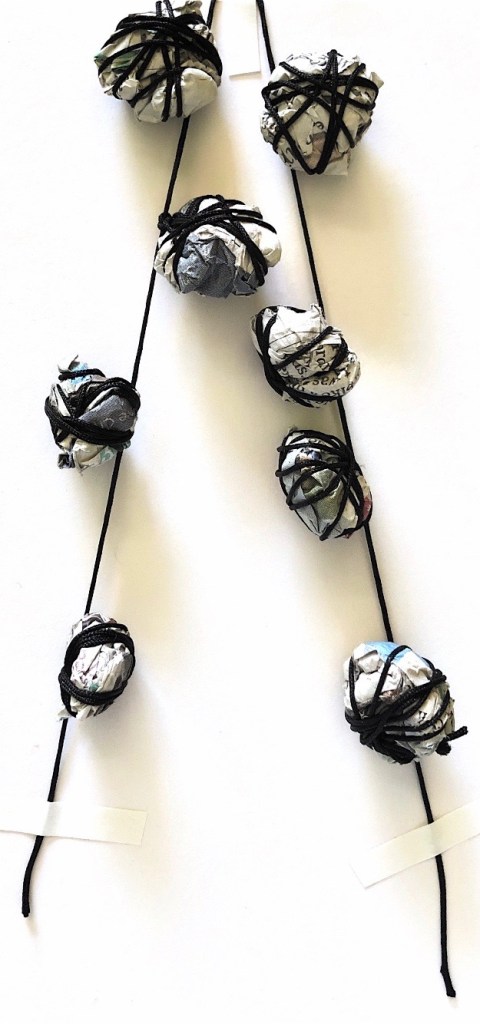
Paper beads, tied yarn wrapped and knotted yarn in black and white, twisted paper with regular knotted strips of twisted paper.
Wire and sequins, crochet and knotted threads
Wire and sequins, crochet paper chain, threaded sequins and knots

30cm lengths of yarn with 5cm repeat

Crochet with threaded ribbon, twisted paper with bubble wrap glued at 5 cm intervals, thread and wire twisted into flower shapes
Twisted paper with thread bows, wire twisted with paper into bud shapes with tied on beads, looped and knotted thread
Scrunched up newspaper wrapped with thread

30cm lengths of yarn with random repeat

Knotted thread with beads and large paper circles
Plaited yarn trapping silk and fabric, crochet loops

1 metre yarns developed from 30 cm samples

Paper beads with knotted threads
Yarn chain with beads and paper circles
Black and white crochet with holes through which lace is inserted.

I really enjoyed this exercise and the development from drawings to lengths of ‘yarn’. I have found that I enjoy intricate work such as the 1 metre length with beads and paper circles – I can see this as an edging. I also love working with paper alongside other materials.

Textiles 1 Part 4 Yarn and linear exploration Research point 1

Yarn research

Researching different companies involved in design of yarns and marketing them showed that the biggest themes at present as in every part of life are sustainability, traceability and innovation.

Some companies such as ‘Woolmark’ and ‘The Campaign for Wool’ focus on education, innovation and a collaboration between wool ‘growers’, designers, retailers, manufacturers, artisans and interior designers.

‘Woolmark’ has a clear website with fashion photos, free courses ,and education which all promote the use of wool. The site concentrates on the properties, production, and finished items rather than specific yarns used. However it does present information about wind and water resistant woollen fabric with yarn produced by the latest spinning techniques. There is traceability from the farms with the sheep through the supply chain to the designers working in conjunction with the company. There is also an innovative process for creating ‘wool denim’ which would make use of the properties of wool to create warm, lightweight denim fabric along with cotton.

‘The Campaign for Wool also has a clear inviting website highlighting HRH The Prince of Wales as the patron. An interesting statement is that woollen garments typically have a life of 2-10 years whereas “fast’ fashion garments are discarded after 2-3 years. This company has an annual wool week in the UK with courses and exhibitions championing the use of woollen yarn.

‘Cotton Inc’ is a not for profit organisation which provides resources and research to help companies develop and market cotton. They can help with quality, innovation, sustainability, and creating a profitable product from the cotton fibre to the finished product.

The ‘Cotton Inc’ site had links to yarn producers and spinners and I chose one to explore further – Cap yarns. This company’s site showed swatches of knitted yarns from their range, with blended fibres creating slubs, streaks and a vintage feel. They have developed a denim look yarn based on the use of a indigo warp and natural weft in woven denim; the resulting yarn has a blue base with a white slub, mimicking the denim look. The look can also be altered for the customer by different dyeing techniques.

‘Invista’ is a company specialising in nylon, polyester and polyurethane products. It focuses on the strength, flexibility and innovation produced by these materials, and is currently developing new products such as a carpet that can capture dust and allergens until they are vacuumed. This company makes a diverse range of products such as the nylon polymers used to make cell phones, and those used to make strong backpacks.

‘Lurex’ has a website showcasing the beautiful yarns it produces with pictures of garments, fabrics and each of its yarns. It has yarns that are transparent, holographic, rainbow effect, translucent and iridescent, with an emphasis on sparkle, glamour and an antique look to some of them. There are glow in the dark yarns, and enamel effect yarns which give a painterly look. The yarns are used for weaving and knitting for fancy effects. I was interested to see information about how some of the effects are achieved for example the creation of gimp which has a central core of viscose with lurex twisted around it, and with a black core gives an antique look to the result. Lurex seem to have a large presence for these types of yarns and their website presents the different products and colours with beautiful photography and clear photos with plenty of information.

‘Pittimmagine’ is a company which presents big shows including catwalk shows, to champion word-scale excellence in yarns. They present ideas that bring fashion, art, sport and design together. They sponsor a student.

‘Heimtextil’ is another company presenting trade fairs, focussing on cultural trends and colours from around the world. It promotes sustainability.

This is an ongoing piece of research and will be added to as I progress.
Printing

Having finished assignment 3, I thought I would have a go at some breakdown printing – not good for me as you have to be patient to let the screen dry!! It was just about dry when I used it to release the colour and patterns and it worked well I think.

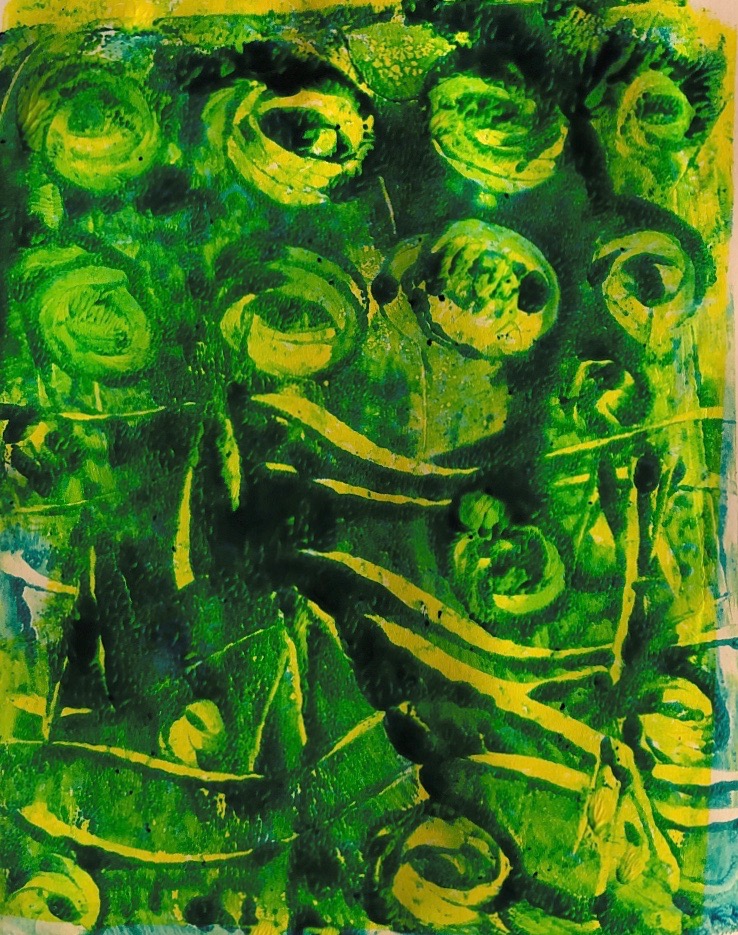
Then I had a go with my Gelli plate – using the same colours.

Here is my screen drying off ready for some more breakdown printing. That will be tomorrow when it is dry…….

The four prints below came from this screen – the orange got a bit lost when I pulled through with green. I think next time it would be best to use a darker/stronger colour for the dried on layer.

Textiles 1 Part 3 Colour studies Written reflection

I have really enjoyed working with colour, developing colour palettes and creating different colour palettes with paint and textiles. Colour mixing was surprising – I needed to think about tone as well as colour, and tone was particularly important for the neutral samples. I experimented with mixing in all sorts of different colours to get the right result.

I have used colours that are not within my usual comfort zone, – colours of glass and unusual colour collage, and learnt lots of techniques to develop different ways of coming up with new ideas for colour, proportion and design – computer applications, use of old paintings, and collage.

Again the sampling and development of ideas has proved so useful in achieving a pleasing result, reinforcing what I learnt in previous studies. I particularly enjoyed the colour wraps – the textures, movement and colours within the materials are exciting to use and create vivid tactile studies. I also created tassels with the materials, and have used yarn to create a stitched piece based on one of the Old Masters. I successfully developed the watercolour studies into 3 crochet pieces to explore further the relationships in the colour palette.

The collage studies pushed me to become more experimental with design and the techniques I learnt will continue to influence my design ideas. It was useful to move away from the original source photo for the final three studies and I was able to use different scales and arrangements while retaining a feel for the original design. I am really pleased with these collages.

My presentation skills are improving and I am proud of my colour resource book, I am looking forward to using it for future studies, and continuing to fill the blank pages.

Assessment Criteria

Demonstration of technical and visual skills

I have used a variety of materials and techniques to present my ideas, and demonstrated my observational skills in my use of colour and materials. I have shown that my design skills are developing with interesting composition.

Quality of outcome

My work has been presented clearly and coherently both in my Colour resource book and my learning log. I have worked hard to ensure my log is clearly categorised and that my assignment is beautiful to look at while being logical and clearly annotated.

Demonstration of creativity

My imagination is becoming more developed with a greater sense of freedom and experimentation, but I want to push myself more to be brave and experiment more. I feel my personal voice shows in my collage and crochet pieces but this is another area that will develop with my studies and experimentation.

Context

This is probably the area that I find most difficult.

I enjoyed the research on textile artists and designers and can relate this to the colour work, seeing how a different colour palette can emerge from observation. I also found that narrowing down a colour palette and creating different palettes from one chosen colour can be an exciting process using computer software.

I still find reflection and critical thinking a difficult process and know I need to continue to work on this.

And finally

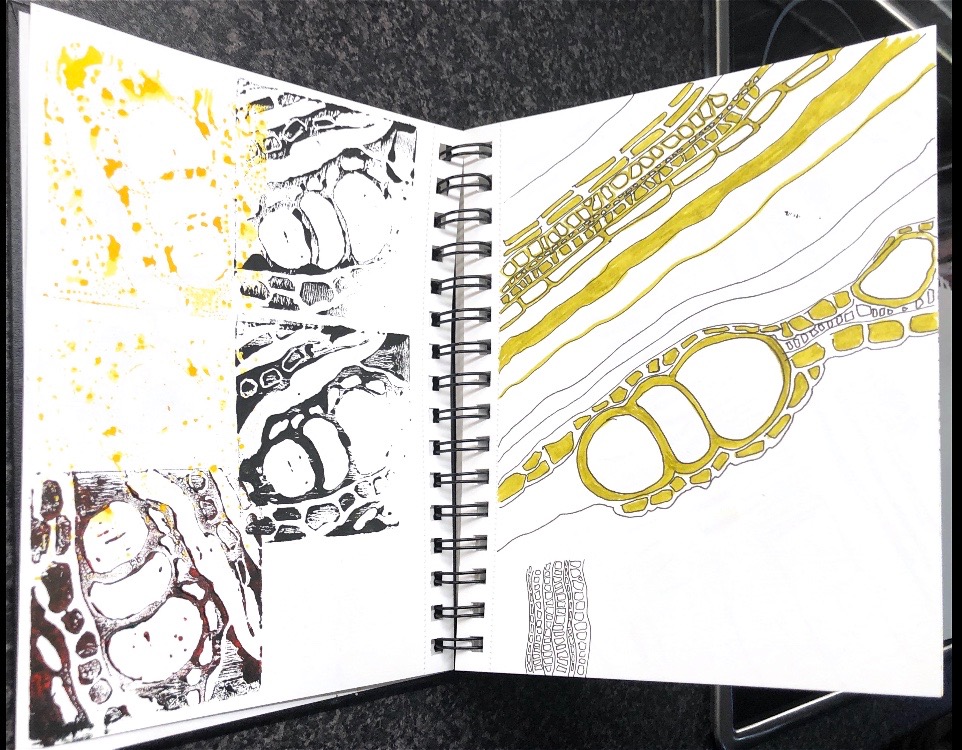
A couple more sketchbook pages